Stable Diffusion
VerifiedStable Diffusion is an open-weight AI image generation model that can be run locally on your own hardware, fine-tuned, and extended with community checkpoints and LoRAs. It is developed by Stability AI, which also offers hosted deployment options including self-hosted licensing, a cloud platform, and an API for teams that don't want to manage infrastructure. It suits developers, artists, and businesses who want control over their image generation pipeline and data, from hobbyists experimenting on a personal GPU to enterprises building custom production workflows.
Stable Diffusion at a glance
- What it is
- Stable Diffusion is an open-weight AI image generation model that can be run locally on your own hardware, fine-tuned, and extended with community checkpoints and LoRAs.
- Who it's for
- Aimed at makers and small teams exploring the Generators category.
- Primary use case
- Stable Diffusion is the open-weight backbone of the AI art ecosystem.
- CategoryAI Image & Art
- Pricing100% Free
- Starting priceFree
- Credit cardNo credit card required
- Foundation modelOpen-Source
- Bring your own keyNot supported
- RatingNo reviews yet. Be the first to rate.
Video Spot
Overview
Stable Diffusion is an open-weight AI image generation model that can be run locally on your own hardware, fine-tuned, and extended with community checkpoints and LoRAs. It is developed by Stability AI, which also offers hosted deployment options including self-hosted licensing, a cloud platform, and an API for teams that don't want to manage infrastructure. It suits developers, artists, and businesses who want control over their image generation pipeline and data, from hobbyists experimenting on a personal GPU to enterprises building custom production workflows.
Stable Diffusion is the open-weight backbone of the AI art ecosystem. Run it on your own GPU, install community checkpoints and LoRAs, and keep full control of your data and outputs.
In detail
Stable Diffusion is the open-weight image generation model behind much of the AI art ecosystem. Because its weights are open, anyone with suitable hardware can download and run it locally, rather than depending solely on a hosted service. This also means it can be modified: users commonly install community-made checkpoints and LoRAs to change style, subject matter, or output quality.
The tool is aimed at a wide range of users. Individual creators and developers can run it on their own GPU to keep full control over their data and outputs, without sending prompts or images to a third-party server. At the other end, Stability AI (the company behind the model) offers enterprise-focused deployment paths, including self-hosted licensing, a managed cloud platform, and an API for teams that want production-ready image generation without managing their own infrastructure.
Stability AI also provides broader solutions beyond the base model, including a strategic partnerships program where its applied AI research team works with enterprise clients to fine-tune custom foundation models on proprietary data, and build production workflows around them. This has been applied to use cases such as automotive synthetic training data, medical imaging support, construction defect detection, and entertainment production workflows like color matching in render pipelines.
What differentiates Stable Diffusion from closed, API-only image models is this openness: the core model can be self-hosted and customized, giving users control over cost, privacy, and fine-tuning, while Stability AI's commercial offerings layer managed hosting, enterprise support, and custom model training on top for teams that need it.
Overall, Stable Diffusion serves anyone from a solo creator experimenting at home to a large enterprise building a custom generative media pipeline, with deployment options spanning self-hosted, cloud, API, and fully custom enterprise engagements.
Common uses
- Running image generation locally for full data control and no per-use fees
- Fine-tuning the model on proprietary or domain-specific imagery
- Integrating image generation into an app or product via API
- Building marketing and brand creative assets at scale
- Generating synthetic training data for specialized domains like automotive or healthcare
- Using community checkpoints and LoRAs for specific art styles
Pros
- Open-weight model gives full control over data and deployment
- Can be run locally without relying on a hosted service
- Extendable with community checkpoints and LoRAs
- Multiple deployment paths: self-hosted, cloud, API, and custom enterprise builds
- Backed by a company offering enterprise support and custom model training
Cons
- Running it locally requires suitable GPU hardware, which isn't explained in the listing
- Enterprise solutions and custom model training appear aimed at larger organizations rather than individuals
- Specific pricing for self-hosted licenses, API, or cloud plans is not disclosed on the pages reviewed
Generated from the listing's details and not yet checked by a Zoipi editor.
Key Features
- Open weights: the model can be downloaded and run on your own hardware
- Self-hosted deployment: deploy in your own environment with a license for full control over data
- Fine-tuning support: train custom models on your own data
- API access: integrate image generation into products without managing infrastructure
- Community extensions: supports third-party checkpoints and LoRAs to customize outputs
- Enterprise custom model program: Stability AI works with businesses to build domain-specific models and workflows
Best For
- Specialists looking for a dedicated tool rather than a general assistant
- Creators exploring Generators
- Anyone testing the space without an upfront budget
- Buyers who want a highly rated, well-established option
Pricing Model
100% Free. Completely free to use — no paywalls and no credit card required.
Pricing Breakdown
Screenshots
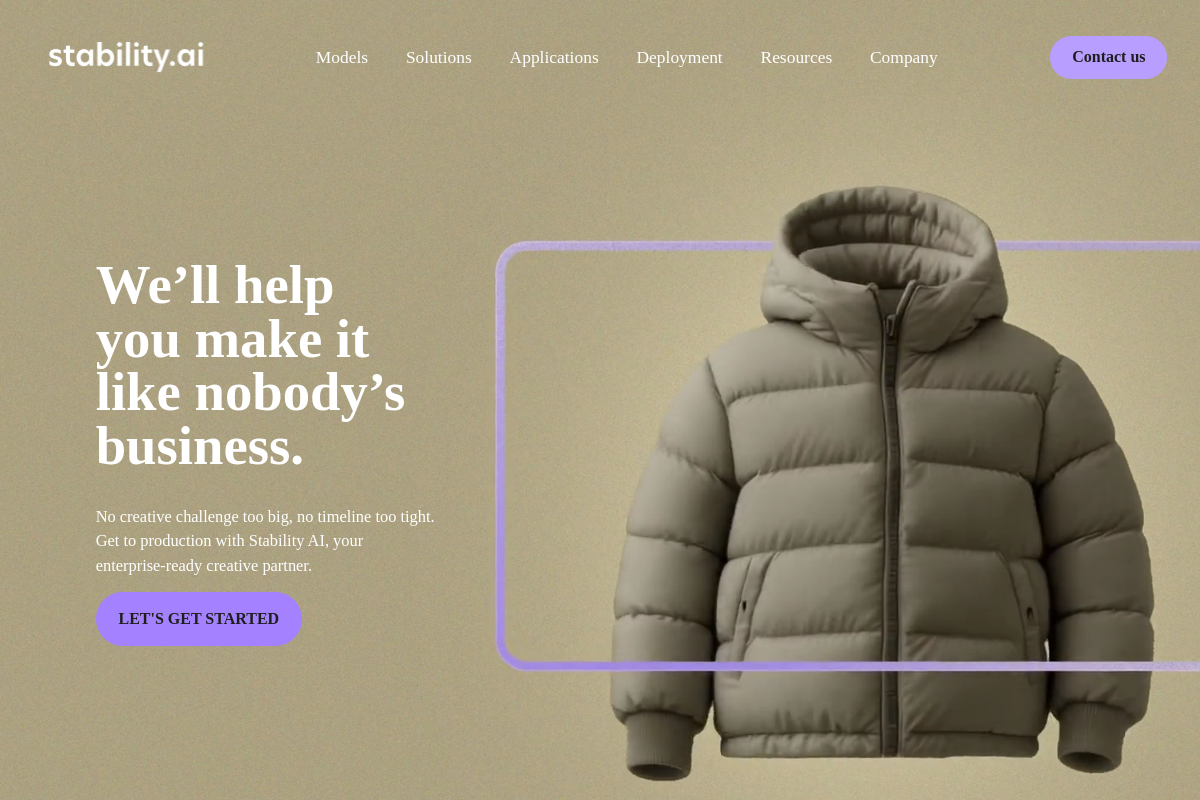
Live preview of Stable Diffusion's website.
Frequently asked questions
Community Reviews & Discussion
0 reviews · replies are moderated before they appear.
- No reviews yet — be the first to review Stable Diffusion.