babyagi
Verifiedbabyagi is an open source Python framework for building self-building autonomous agents. It centers on functionz, a function management system that stores, loads, and executes functions from a database, tracking dependencies, imports, and authentication secrets. It includes a web dashboard for registering functions, visualizing dependencies, managing secret keys, and reviewing execution logs. The project is aimed at experienced developers who want to experiment with autonomous agent concepts rather than deploy production systems. It evolved from the original 2023 BabyAGI task-planning agent, which has since been archived. Users install it via pip and interact with it through Python code and a local dashboard.
babyagi at a glance
- What it is
- babyagi is an open source Python framework for building self-building autonomous agents.
- Who it's for
- A good fit for users working with Autonomous Task Agents who want to cut the manual steps.
- Primary use case
- babyagi — AI tool at babyagi.org.
- CategoryAutonomous Task Agents
- PricingFree Tier
- Starting priceFree, paid plans available
- Credit cardNo credit card required
- Foundation modelGPT-4o
- Bring your own keySupported
- RatingNo reviews yet. Be the first to rate.
Video Spot
Overview
babyagi is an open source Python framework for building self-building autonomous agents. It centers on functionz, a function management system that stores, loads, and executes functions from a database, tracking dependencies, imports, and authentication secrets. It includes a web dashboard for registering functions, visualizing dependencies, managing secret keys, and reviewing execution logs. The project is aimed at experienced developers who want to experiment with autonomous agent concepts rather than deploy production systems. It evolved from the original 2023 BabyAGI task-planning agent, which has since been archived. Users install it via pip and interact with it through Python code and a local dashboard.
babyagi — AI tool at babyagi.org.
In detail
babyagi is an experimental, open source Python framework for creating self-building autonomous agents. It is the successor to the original BabyAGI released in March 2023, which pioneered task planning for autonomous agents and has since been archived in a separate repo. The current version shifts focus toward a simpler foundational idea: the best way to build a general autonomous agent is to build the simplest system that can build itself.
At its core is functionz, a framework for storing, managing, and executing functions from a database. Functions can be registered with metadata such as imports, dependencies on other functions, required secret keys, and descriptions. This creates a graph-based structure that tracks how functions relate to and depend on one another, with automatic loading of dependencies and detailed logging of every execution.
The tool is intended for experienced developers who want to explore ideas around autonomous agents and function-based architectures. It is explicitly described as not meant for production use, and the maintainer notes they have no professional developer background, positioning the project as a space for discussion and experimentation rather than a polished commercial product.
babyagi comes with a dashboard that provides a user-friendly interface for managing functions, visualizing dependencies, handling secret keys, and monitoring logs of executions, including inputs, outputs, execution time, and errors. It also supports triggers, which let functions automatically execute in response to events such as another function being added or updated, enabling more autonomous workflows. Two pre-loaded function packs are included: a set of default functions for execution, key management, triggers, and logs, and an AI function pack that can auto-generate descriptions and embeddings and help select or combine existing functions based on prompts.
What differentiates babyagi from many other agent frameworks is its emphasis on self-building behavior: it includes experimental self-building agents that can decide whether to reuse an existing function or generate new ones by breaking tasks into smaller reusable components. This makes it more of a research and tinkering tool than a ready-made product, appealing to developers interested in the mechanics of autonomous, self-extending systems.
Common uses
- Experimenting with autonomous agent architectures as a developer
- Organizing and managing interdependent Python functions with automatic dependency resolution
- Building a self-building coding agent that writes new functions from existing ones
- Logging and debugging function execution across a complex system
- Managing API keys and secrets needed by various functions in one place
Pros
- Open source and installable via pip
- Includes a dashboard for visual management of functions and logs
- Supports automated workflows through triggers
- Comes with pre-loaded function packs to get started quickly
Cons
- Explicitly not intended for production use
- Built and maintained by someone without professional developer experience, per the project's own disclaimer
- Experimental nature means features like self-building agents are still in draft/early stages
- No stated pricing or hosted service; requires local setup and coding knowledge
Generated from the listing's details and not yet checked by a Zoipi editor.
Key Features
- functionz framework: stores, manages, and executes functions from a database with dependency tracking
- Function metadata: supports imports, dependencies, key_dependencies, and descriptions for each registered function
- Dashboard: web interface for managing functions, viewing dependencies, and monitoring logs
- Secret key management: add and manage API keys and secrets through code or the dashboard
- Logging system: tracks execution inputs, outputs, execution time, and errors for every function call
- Triggers: automatically execute functions in response to events like another function being added or updated
- Pre-loaded function packs: default functions for execution/logging and an AI generator pack for descriptions and embeddings
- Self-building agents: experimental agents that reuse or generate functions by breaking tasks into reusable components
Best For
- Specialists who want a dedicated autonomous task agents tool rather than a general assistant
- Anyone testing the space without an upfront budget
- Buyers who want a highly rated, well-established option
Pricing Model
Free Tier. Generous ongoing free tier you can start with, no credit card needed. Paid plans unlock higher limits.
Pricing Breakdown
Screenshots
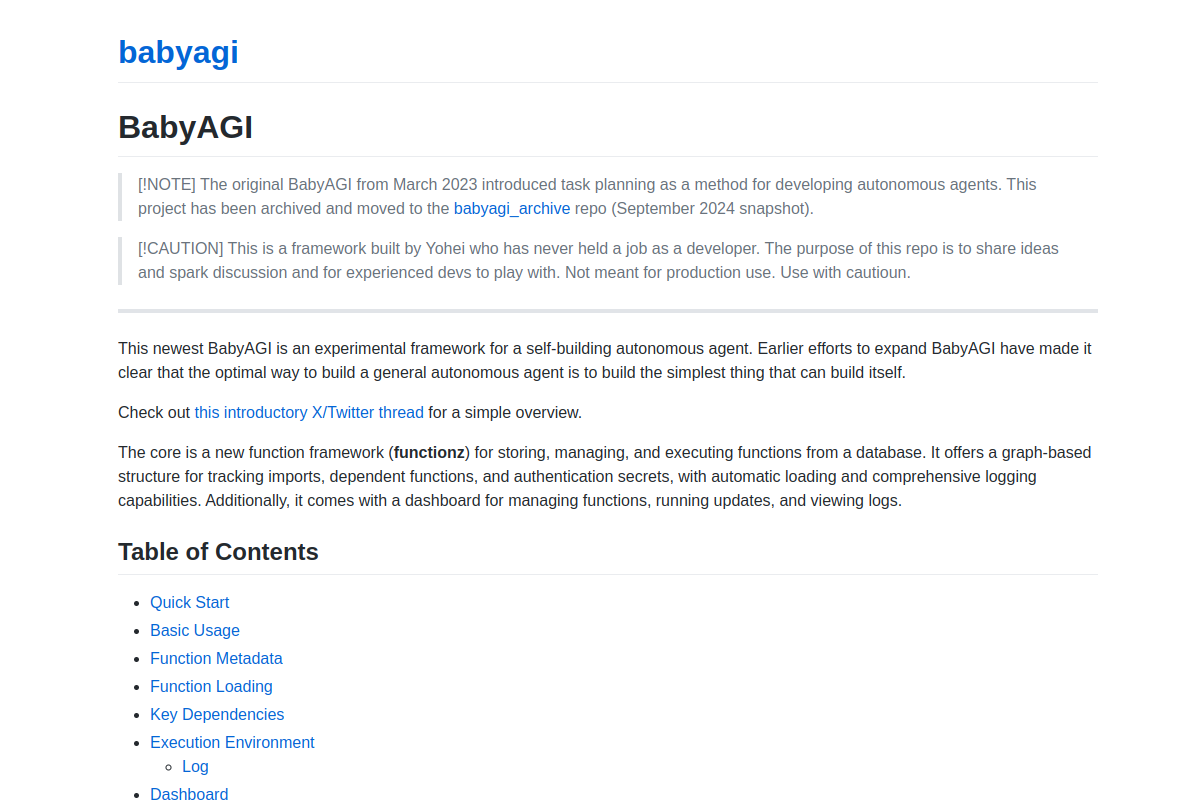
Live preview of babyagi's website.
Frequently asked questions
Community Reviews & Discussion
0 reviews · replies are moderated before they appear.
- No reviews yet — be the first to review babyagi.