Augment Code
VerifiedAugment Code is a platform called Cosmos that runs AI agents across the software development lifecycle for engineering organizations. Instead of individual engineers using one-off AI coding assistants, Cosmos lets teams build connected automated workflows, called loops, that handle tasks like code review, ticket-to-PR implementation, vulnerability remediation, and incident response. Agents wake on triggers such as pull requests, alerts, schedules, or webhooks, do the work in isolated sandboxes, and hand off to humans only at defined checkpoints. It is built for engineering teams and organizations wanting to scale agentic development beyond individual developer tools, with context engine, CLI, and cloud agent capabilities, plus security features like SOC 2 compliance.
Augment Code at a glance
- What it is
- Augment Code is a platform called Cosmos that runs AI agents across the software development lifecycle for engineering organizations.
- Who it's for
- Worth a look if projects involving Autonomous Coding Agents come up often in your week.
- Primary use case
- Your engineers have agents.
- CategoryAutonomous Coding Agents
- PricingFree Tier
- Starting price$20/month
- Credit cardNo credit card required
- Foundation modelMulti-model
- Bring your own keySupported
- RatingNo reviews yet. Be the first to rate.
Video Spot
Overview
Augment Code is a platform called Cosmos that runs AI agents across the software development lifecycle for engineering organizations. Instead of individual engineers using one-off AI coding assistants, Cosmos lets teams build connected automated workflows, called loops, that handle tasks like code review, ticket-to-PR implementation, vulnerability remediation, and incident response. Agents wake on triggers such as pull requests, alerts, schedules, or webhooks, do the work in isolated sandboxes, and hand off to humans only at defined checkpoints. It is built for engineering teams and organizations wanting to scale agentic development beyond individual developer tools, with context engine, CLI, and cloud agent capabilities, plus security features like SOC 2 compliance.
Your engineers have agents. Your organization doesn't. Cosmos is the platform that closes the gap.
In detail
Augment Code offers Cosmos, a platform for running AI agents across an organization's entire software development lifecycle rather than just assisting individual developers. The core idea is to build 'loops': ongoing automated systems that handle recurring engineering work such as code review, ticket-to-PR implementation, vulnerability remediation, and incident response, with human engineers approving work only at defined checkpoints.
Cosmos is intended for engineering organizations and teams, not just individual coders. Teams can use prebuilt Experts (reusable agent templates with their own environment, capabilities, and memory) for tasks like deep code review, CI failure investigation, dependency upgrades, and incident coordination, or build and fork their own. A conversational Advisor helps set up a loop by asking what is needed, proposing a plan of Experts and automations, and then deploying it live.
The platform works by connecting to native triggers across tools like GitHub, GitLab, Slack, Linear, and Jira, and typed webhooks for others. Work runs in isolated sandboxed VMs that can be managed cloud compute, a company's own machines via a self-hosted daemon, or a mix of both. A Context Engine provides codebase understanding, and a model router (Prism) can route work across multiple LLMs such as Claude and Gemini models based on cost and quality needs.
What differentiates Cosmos, according to the company, is its focus on connected loops rather than single agent sessions: triage feeds authoring, authoring feeds review, and incident postmortems feed new tickets, with shared memory across runs so corrections improve future work. It also emphasizes human-in-the-loop quality gates, meaning consequential actions require human approval rather than running fully autonomously.
Pricing is usage-based with flat monthly team plans that pool usage and seats, plus an Enterprise tier with custom pricing, SSO, and compliance features like CMEK and ISO 42001. Security controls include SOC 2 Type II compliance and a stated policy of not training on customer data on paid plans.
Common uses
- Automated first-pass code review on every pull request
- Turning an assigned ticket into a reviewed, merged pull request
- Investigating and remediating security vulnerabilities from alerts
- Coordinating incident response by assembling context before an on-call engineer joins
- Running recurring engineering workflows like dependency upgrades as automations
- Onboarding new engineers faster using standardized agent workflows
Pros
- Connects multiple stages of the SDLC into automated loops rather than isolated agent sessions
- Offers prebuilt Experts that can be forked and customized instead of starting from scratch
- Supports flexible deployment including self-hosted compute for code that cannot leave the building
- Human approval checkpoints are built in rather than fully autonomous operation
- SOC 2 Type II compliance and a stated no-AI-training policy on paid plans
Cons
- No free plan; paid plans start at $20/month and usage-based costs can add up with top-ups
- Enterprise-level security features like SSO, CMEK, and ISO 42001 are reserved for the custom Enterprise tier
- Community-based support only on Standard and Business plans, with full SLA support limited to Enterprise
- Setup assumes integration with tools like GitHub, Jira, Slack, or Linear, which may limit fit for teams outside those ecosystems
Generated from the listing's details and not yet checked by a Zoipi editor.
Key Features
- Cosmos platform: runs fleets of AI agents across the SDLC with triggers, environments, and checkpoints
- Prebuilt Experts: reusable agent templates for code review, ticket dispatch, incident investigation, and more
- Advisor setup: conversational tool that proposes and deploys a loop of Experts and automations
- Context Engine: provides codebase understanding to agents
- Prism model router: routes work across models like Claude and Gemini based on cost and quality
- Native integrations: triggers from GitHub, GitLab, Slack, Linear, Jira, schedules, and webhooks
- Flexible compute: managed cloud sandboxes, self-hosted daemon on your own machines, or both
- Human-in-the-loop checkpoints: work pauses for review and resumes on human reply
Best For
- Anyone replacing a manual autonomous coding agents process with something faster
- Anyone testing the space without an upfront budget
- Buyers who want a highly rated, well-established option
Pricing Model
Free Tier. Generous ongoing free tier you can start with, no credit card needed. Paid plans unlock higher limits.
Pricing Breakdown
Screenshots
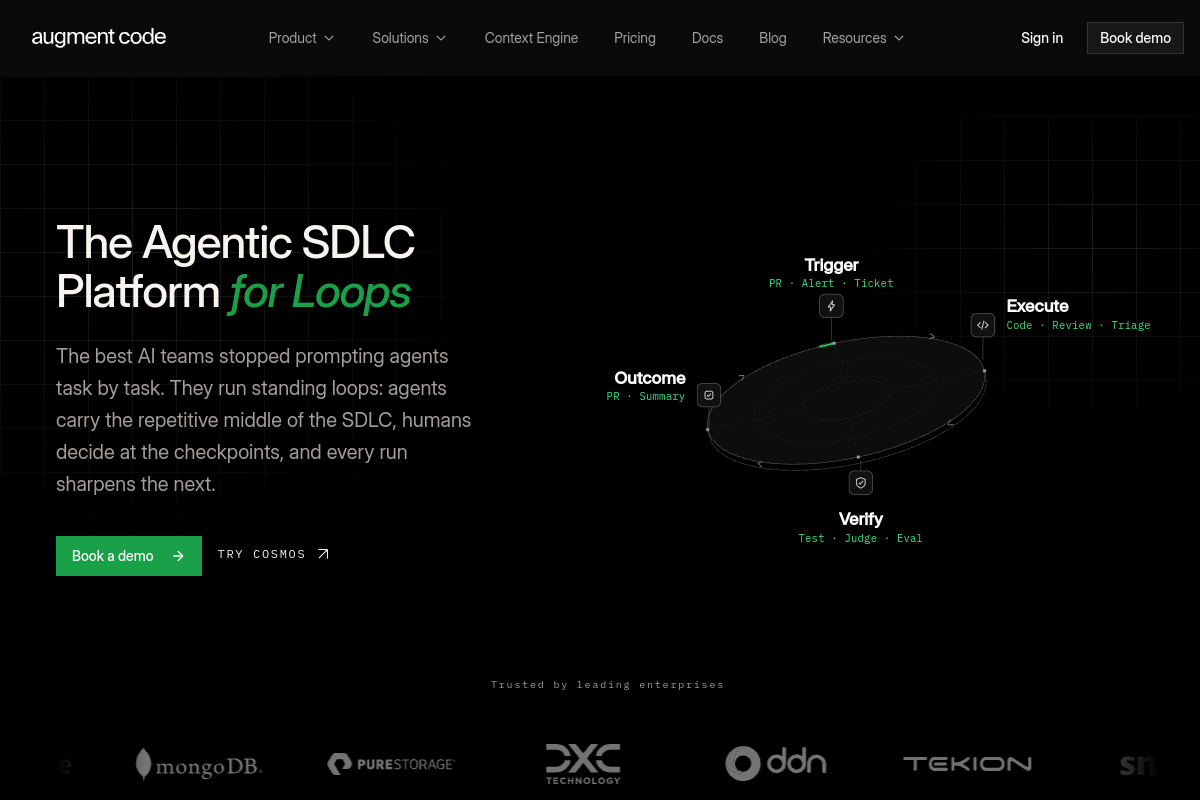
Live preview of Augment Code's website.
Frequently asked questions
Community Reviews & Discussion
0 reviews · replies are moderated before they appear.
- No reviews yet — be the first to review Augment Code.